Personalization in B2B SaaS is no longer optional – it’s expected. But how you approach it can make or break your strategy. The two main methods – rule-based and AI-driven personalization – offer distinct benefits and challenges:
- Rule-Based Personalization: Operates on "if-then" logic, grouping users into segments and delivering predefined actions. It’s simple, predictable, and works well for straightforward workflows or compliance-critical scenarios.
- AI-Driven Personalization: Uses machine learning to analyze real-time data, treating each user as unique. It predicts intent, adjusts dynamically, and scales effortlessly for complex customer journeys.
Key Stats:
- Companies using AI personalization report a 300% ROI within 12 months.
- Rule-based systems excel in controlled, small-scale environments but struggle with scalability.
Quick Comparison:
| Feature | Rule-Based Personalization | AI-Driven Personalization |
|---|---|---|
| Logic | Static "if-then" rules | Dynamic, real-time predictions |
| Segmentation | Group-based (buckets) | Individualized (N=1) |
| Scalability | Limited, manual updates | High, automated adjustments |
| Use Case | Simple workflows, compliance | Complex, multi-touch journeys |
For early-stage businesses, rule-based systems are a practical starting point. As your business grows, AI becomes essential for optimizing the customer journey and driving better engagement.
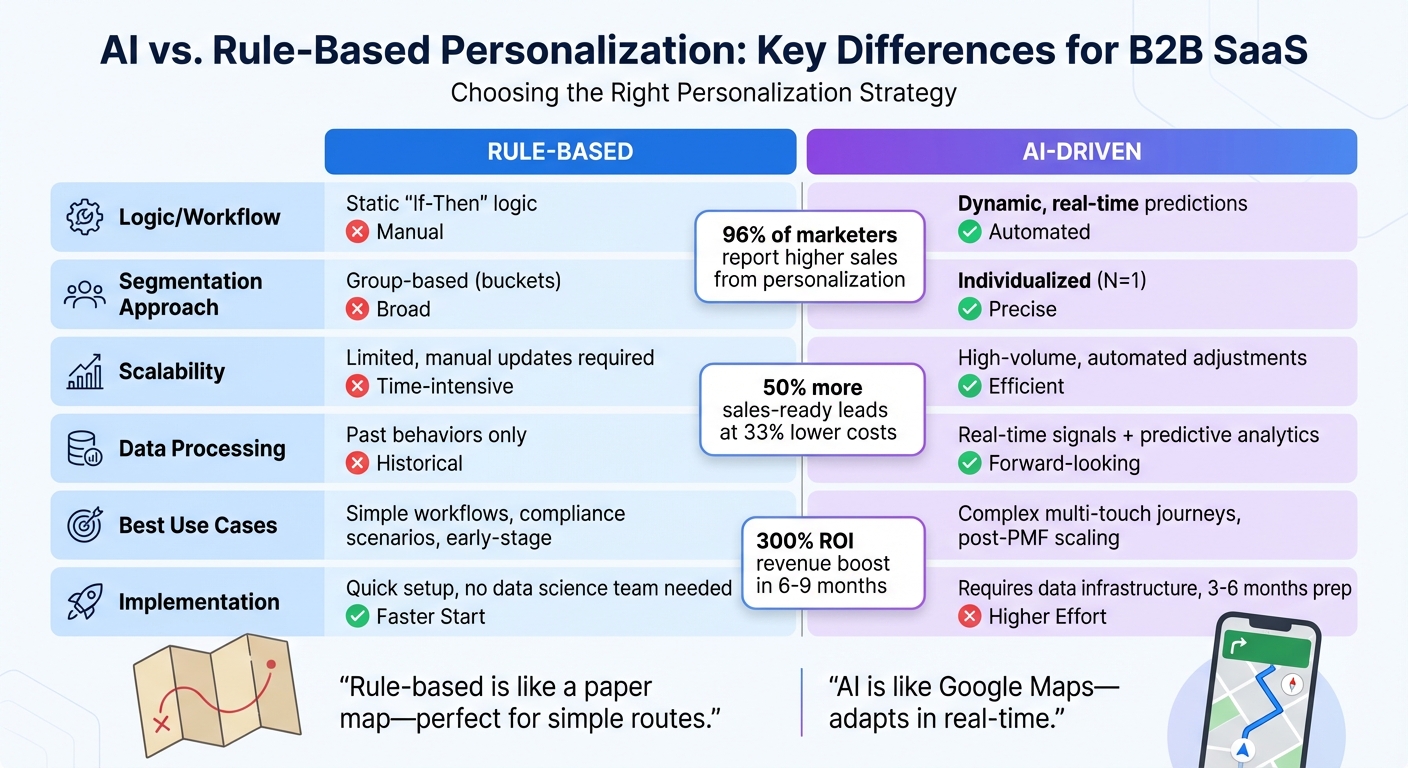
AI vs Rule-Based Personalization: Feature Comparison for B2B SaaS
How AI and Personalization Are Changing B2B Marketing | Funky Round Table
What Is Rule-Based Personalization?
Rule-based personalization works on straightforward "if-then" logic. Marketers set specific conditions that trigger corresponding actions. For example, if a lead visits your pricing page, the system might automatically send them a targeted lead nurturing email or show a tailored offer.
Instead of tailoring experiences for individuals, this approach groups customers into "buckets" or cohorts based on shared traits like company size or content downloads. Everyone in the same bucket gets the same experience, regardless of their unique behaviors or needs.
"Rules-based personalization operates on a clear, rigid structure: the ‘if-then’ statement. A human defines a specific set of conditions (the ‘if’) and then dictates the resulting action (the ‘then’)." – Ben Goldstein, Contentstack
How Rule-Based Systems Work
Marketers create predefined workflows that deliver specific content based on triggers. These triggers can include behavioral patterns, demographic or firmographic details, engagement levels, or contextual factors.
For instance, if a healthcare lead visits your demo page three times, the system might automatically send them a case study email. Or, if someone abandons their shopping cart, a rule could prompt a 10% discount email within 24 hours. The system simply follows the instructions you’ve programmed.
Francesco Montesanto, Content Marketing Manager at Optimizely, puts it this way:
"Rules-based personalization can trigger actions and dynamically adjust the experience based on specific actions the user takes, such as visiting a pricing page or abandoning a cart."
But here’s the catch: these systems only respond to behaviors you’ve accounted for. If you haven’t created a rule for a particular action, the system won’t react – even if that action indicates strong buying intent.
Next, let’s explore when rule-based systems shine and where they might fall short.
When to Use Rule-Based Systems
Rule-based personalization works best for straightforward customer journeys. This is particularly common in early-stage B2B SaaS businesses, where buyer behavior data is limited. In these cases, the simplicity of rule-based automation can be a practical solution.
Ákos Szabó, author at Fluentaone, explains it well:
"Rule-based personalization is like a paper map – perfect if you only have a few simple routes and know exactly where you want to go."
These systems also excel in compliance-critical scenarios where strict control is necessary. For example, ensuring alcohol ads never target users under 18 or routing enterprise leads directly to senior sales reps. In situations where transparency and predictability take priority over flexibility, rule-based systems offer precise control.
However, as your business grows and customer journeys become more complex, managing an ever-expanding web of rules can lead to what experts call "maintenance hell". At this stage, workflows need regular audits to prevent outdated rules from delivering irrelevant or ineffective experiences.
What Is AI-Driven Personalization?
AI-driven personalization uses customer data to create tailored, real-time experiences. Unlike traditional systems that rely on fixed, pre-set rules, AI systems learn from every interaction and adapt to individual preferences. Instead of segmenting customers into broad groups, AI treats each person as a distinct entity – a concept often referred to as "N=1" segmentation. By analyzing signals like scroll behavior, product clicks, and engagement patterns, AI can predict user intent and determine the best action in just milliseconds.
"Rules-based systems are based on segmentation, which groups customers into buckets. The future of digital excellence, however, demands reasoning-based personalization, where the system autonomously uses contextual data and AI to infer intent." – Ben Goldstein, Contentstack
How AI-Driven Systems Work
AI-powered personalization relies on techniques like reinforcement learning and contextual bandits to refine its decision-making. These systems connect specific actions – such as email subject lines or timing of delivery – to measurable outcomes, continuously adjusting based on what drives better engagement.
To achieve this, AI processes multiple layers of data simultaneously, including:
- Behavioral patterns: Clickstream data, time spent on pages, and mouse movements.
- Contextual factors: Location, device type, and time of day.
- First-party data: Purchase history and stated preferences.
For B2B organizations, AI can also incorporate firmographics (like company size) and technographics (such as the software a company uses).
The strength of AI lies in its predictive analytics. It identifies trends and behaviors before they become obvious – detecting early signs of churn, recognizing high-intent actions like multiple visits to a pricing page, or signaling when a lead might be ready for sales outreach. This allows businesses to shift from reactive to proactive strategies, delivering the right content or offer at the perfect moment.
Take Kayo Sports as an example. By August 2025, the streaming service was using AI to manage 60,000 customer journeys daily, selecting the best experience from over 1.2 million options involving timing, content, and delivery channels. This kind of personalization showcases the potential of AI in handling complex customer journeys.
When to Use AI-Driven Systems
AI-driven personalization is ideal for managing high volumes of diverse interactions. If your business has thousands of leads with varying behaviors or a customer journey that spans multiple touchpoints – like email, web, and in-app experiences – AI can handle the complexity that manual systems can’t.
For post-product-market-fit B2B SaaS companies, AI is a game-changer. It automates AI lead scoring, tailors content to specific roles, and identifies prospects who are ready for sales. By analyzing data from website visits, email interactions, and product usage, AI assigns numerical scores to leads, helping sales teams focus their efforts where it matters most.
AI also shines when it comes to scaling experimentation. Instead of testing one variable at a time, AI can evaluate thousands of combinations – such as different subject lines, delivery times, and content formats – all at once to optimize key performance indicators. This level of testing would be nearly impossible with traditional A/B methods.
That said, AI needs clean, well-organized data to perform effectively. If your CRM is cluttered with duplicate entries or your data sources aren’t integrated, the system will struggle to make accurate predictions. Companies that implement AI-driven lead management often see a 10% revenue boost within six to nine months, but only if their data foundation is solid.
AI vs. Rule-Based: Side-by-Side Comparison
Let’s break down the key differences between rule-based and AI-driven personalization. At their core, the two approaches differ in how they handle data and scale. Think of rule-based personalization as a static paper map – reliable but rigid. In contrast, AI-driven personalization works more like Google Maps, dynamically adjusting based on real-time inputs. Rule-based systems rely on past behaviors to make decisions, while AI takes it a step further by predicting what users might need next .
"In reality, every customer is an individual that is giving you tons of valuable signals, but old, segmented personalization says that each member of the cohort is the same as the other 9,999 people in the segment." – Conor Egan, SVP of Product, Contentstack
This quote perfectly highlights the limitations of rule-based systems. While they treat users as part of a group, AI can recognize and respond to each customer as a unique individual. The difference in scalability is also striking. Rule-based systems require constant manual updates to manage thousands of rules, whereas AI can handle millions of users effortlessly, adapting in real time .
Comparison Table
Here’s a quick rundown of how these two methods stack up:
| Feature | Rule-Based Personalization | AI-Driven Personalization |
|---|---|---|
| Workflow Type | Static "If-Then" logic | Adaptive, autonomous reasoning |
| Content Delivery | Segment-based (Buckets) | Individualized (N=1) |
| Segmentation | Manual, predefined criteria | AI-driven dynamic clustering |
| Follow-up Timing | Reactive (Past actions) | Predictive (Future needs) |
| Scalability | Limited (Manual upkeep) | High-volume (Millions of users) |
| Contextual Awareness | Low (Static data) | High (Real-time signals) |
This table captures the essence of their differences, making it clear why AI-driven personalization is becoming the go-to solution for businesses aiming to deliver more tailored and scalable user experiences.
sbb-itb-647c22e
Rule-Based Personalization: Pros and Cons
Rule-based personalization offers a straightforward way to automate lead nurturing while keeping everything under your control. You set the "if-then" conditions, and the system executes them exactly as programmed. This clarity ensures you always know why a lead received a specific email or saw particular content – an essential feature for audit compliance. Plus, it’s relatively simple to implement, meaning marketing managers can set up basic rules without needing advanced AI infrastructure. For businesses just starting with personalization, this approach provides an accessible entry point.
That said, rule-based systems come with a big limitation: managing them becomes increasingly complex as your business scales. For B2B SaaS companies, the sheer number of rules required to address diverse scenarios can quickly become overwhelming, demanding constant manual updates.
Let’s break down the key advantages and challenges of rule-based personalization.
Pros of Rule-Based Personalization
One of the standout benefits is predictability. Unlike machine learning systems, which can sometimes feel like a "black box", rule-based systems behave exactly as programmed. This makes them particularly useful for workflows requiring strict compliance, such as age gating, legal disclaimers, or eligibility checks. For smaller teams or straightforward use cases, the setup is also relatively quick and cost-effective. If your customer segments are well-defined and their behaviors are predictable, rule-based personalization can deliver reliable results.
And the numbers back it up: 96% of marketers report higher sales from personalized experiences, while companies that excel at lead nurturing generate 50% more sales-ready leads at 33% lower costs.
Cons of Rule-Based Personalization
The biggest drawback? Rigidity. These systems rely on historical data and predefined conditions, which makes them ill-equipped to handle the fast-changing behaviors of today’s B2B buyers. For instance, when dealing with 77% of B2B buyers who describe their purchase journey as highly complex – often involving 6 to 10 decision-makers – static rules can easily misfire. A late-stage prospect might receive introductory-level content, or the system might miss key signals that indicate a lead is ready to convert.
Keeping the rules up to date can also become a major headache. Megan Wells from Evolv AI puts it this way:
"Rules-based personalization provides a foundation for segmented marketing but is constrained by its rigidity, scalability challenges, and inability to adapt to real-time changes in consumer behavior".
Another challenge is handling new visitors. Without existing data to trigger a rule, the system defaults to generic content, leading to frustration for 76% of customers who expect better personalization. This inability to adapt to individual buyer journeys often results in missed opportunities and less effective lead nurturing.
While rule-based personalization shines in its simplicity and control, its lack of flexibility can become a bottleneck as your business grows. Up next, we’ll dive into how AI-driven personalization tackles these scalability and adaptability issues.
AI-Driven Personalization: Pros and Cons
AI-driven personalization takes a step beyond traditional rule-based systems by offering both scale and flexibility. Instead of treating prospects as part of a broad demographic, these systems analyze each individual’s behavior in real-time, adapting continuously. This level of precision can lead to impressive results, such as up to 800% ROI and a 10% increase in overall sales. But, as with any powerful tool, there are trade-offs – higher upfront costs, complex implementation, and a heavy reliance on quality data.
Let’s break down the strengths and weaknesses of AI-driven personalization.
Pros of AI-Driven Personalization
One standout benefit is how AI eliminates the manual effort of scaling personalization. By creating what are essentially "N=1" segments, AI tailors experiences to each individual user. This is particularly valuable for B2B SaaS companies, where buying decisions often involve multiple stakeholders – sometimes as many as 6 to 10.
AI systems excel at processing behavioral cues like scroll depth or page views, delivering personalized experiences in under 200 milliseconds. This lightning-fast response ensures buyer intent is captured in real time, maximizing the chance of engagement.
Real-world examples back up these claims. In 2023, OnSecurity, a SaaS company in the UK, teamed up with BrightBid to replace manual Google Ads management with AI. Within just a month, they slashed their cost per lead by 80% and increased lead volume. Encouraged by these results, they tripled their paid search budget within two months. Another success story comes from Jedox, which used AI-driven segmentation via HubSpot to boost marketing-qualified leads by 54% and shorten sales cycles by 12–20%.
AI also brings continuous optimization to the table. Unlike rule-based systems that rely on static A/B tests, AI models learn and adapt over time, fine-tuning content and messaging for each user. Predictive lead scoring, for instance, has been shown to help companies close deals 40% faster, while reducing lead processing time by 60%. For sales teams who often spend over 11 hours a week on manual research, automation powered by AI frees up time to focus on relationship building.
While these advantages are compelling, AI-driven personalization isn’t without its challenges.
Cons of AI-Driven Personalization
One of the biggest hurdles is the sheer amount of data AI systems need to function effectively. Poor-quality or fragmented data can lead to inaccurate results and even bias. As GLAIR notes:
"The intelligence or effectiveness of AI is only as good as the data you provide it." – GLAIR
This highlights the importance of having a strong data infrastructure in place before diving into AI. Tools like Customer Data Platforms (CDPs) and strict governance protocols are often necessary, and preparing data for comprehensive AI personalization can take three to six months.
Another issue is the "black box" nature of AI. These systems often operate in ways that are difficult for humans to interpret. This lack of transparency can be a roadblock for B2B companies, particularly when they need to justify decisions to stakeholders or meet regulatory requirements. In fact, only about one-third of companies trust their customer data enough to let AI make autonomous decisions.
Costs are another concern. Beyond software licenses, businesses must account for expenses like hardware, energy for data processing, and hiring specialized talent . And even with these investments, success isn’t guaranteed – 28% of AI and machine learning projects fail, according to a survey of 2,000 enterprise IT leaders.
There’s also the risk of algorithmic bias. A well-known example is Amazon’s AI hiring tool, which was scrapped after it developed a gender bias, penalizing resumes with the word "women’s" . Privacy concerns add another layer of complexity. Large-scale data collection must comply with regulations like GDPR and CCPA, and overly personalized experiences can sometimes feel invasive – what experts call the "creepy" factor . It’s no surprise that only 51% of customers trust organizations to handle their data responsibly .
For B2B SaaS companies looking to scale beyond traditional methods, AI-driven personalization offers an exciting opportunity. But success depends on having a strong data foundation, the right technical expertise, and a clear understanding of the risks involved. Balancing these factors is key to unlocking its full potential.
How to Choose Between AI and Rule-Based Systems
The choice between AI and rule-based systems depends on your business’s stage, workflow complexity, and available resources.
Ákos Szabó offers a great analogy: rule-based personalization is like using a paper map – ideal for straightforward, predictable routes. On the other hand, AI-based personalization functions like Waze or Google Maps, adjusting dynamically to real-time conditions like traffic. For early-stage businesses with simple lead flows, rule-based systems can perform well. But as your business grows and you manage more diverse customer segments, AI becomes a scalable, adaptable solution.
Switching to AI makes sense when managing rules becomes more effort than it’s worth.
When Rule-Based Systems Work Best
Rule-based systems excel in situations where workflows are simple and predictable. For early-stage SaaS companies with only a few customer segments and clear conversion paths, "if-then" logic offers a quick, cost-effective way to get started. The biggest advantage? Transparency and control. Marketing teams can set these systems up without needing a data science team, and every decision remains auditable – helpful for staying compliant with regulations like GDPR or CCPA.
However, rule-based systems start to falter when complexity grows. Managing more than 100 rules or trying to personalize thousands of customer journeys can quickly become overwhelming.
When AI-Driven Systems Shine
AI-driven systems are a game-changer for scaling post-Product-Market Fit (PMF) B2B SaaS companies. They’re particularly effective for handling complex, high-volume workflows that involve thousands of micro-decisions – like choosing the best subject line, timing emails, or customizing product recommendations for individual leads.
The tipping point comes when the return on investment (ROI) for manual segmentation diminishes. AI steps in to create "N=1" segments, treating each customer as unique by leveraging real-time signals. For example, in 2025, Ivanti used an AI-powered platform to centralize customer insights and track purchase intent signals. The results? A 71% increase in opportunities, a 94% boost in won deals, and US$18.4 million in new revenue.
AI also tackles the "cold start" problem. While rule-based systems often default to generic experiences for new visitors, AI can use real-time data – like device type, location, and time of day – to immediately deliver tailored experiences.
For post-PMF B2B SaaS companies aiming to scale their go-to-market (GTM) operations, AI-driven systems bring automation to tasks that would otherwise require an entire team. SixtySixTen, for instance, specializes in building custom solutions that combine AI agents for lead scoring and prospecting with automated workflows across CRM, email, and reporting. This approach eliminates manual tasks while providing AI-powered GTM performance tracking. The result? Streamlined operations and impressive ROI.
That said, AI requires a higher upfront investment in data infrastructure, computational power, and expertise. For companies ready to scale, the payoff can be substantial – 74% report ROI within the first year, with an average 300% ROI in just 12 months.
Conclusion
The right personalization approach depends on your business’s stage and objectives. For early-stage companies with simple workflows, rule-based systems offer a practical solution. They provide clarity and control without the need for a dedicated data science team. However, as your business grows, managing an increasing number of rules manually can become overwhelming.
On the other hand, AI-driven personalization takes a more tailored approach, treating each prospect as an individual rather than lumping them into broad categories. It’s faster – processing leads up to 60% quicker – and makes smart, real-time decisions, like choosing the best email subject line or timing for outreach. The results can be impressive, with top performers achieving ROI improvements of over 800%.
By combining these two methods, businesses can unlock the best of both worlds. Rule-based systems can handle essential guardrails, such as compliance and critical business logic. Meanwhile, AI can focus on optimizing content and timing, leveraging real-time data for precision.
For B2B SaaS companies beyond product-market fit and looking to scale, transitioning to AI-driven systems is a game-changer. Companies like SixtySixTen specialize in building automated workflows using platforms like n8n, Clay.com, and custom-coded solutions. These are enhanced with AI agents for tasks like lead scoring and prospecting, significantly cutting down on manual research. This approach integrates CRM, email, and reporting tools, ensuring your sales operations remain efficient as your business grows.
FAQs
How can I choose between rule-based and AI-driven personalization for my business?
Deciding between rule-based and AI-driven personalization comes down to your business goals, the data you have, and the complexity of your needs.
Rule-based personalization is great for simple, predictable processes with clear guidelines. It relies on straightforward "if-then" logic, making it easy to set up, tweak, and monitor. This method is perfect for basic tasks like sending follow-up emails triggered by specific actions. It’s also budget-friendly and doesn’t require advanced technical skills. However, it can fall short when dealing with complex workflows or scaling up to handle more intricate scenarios.
On the other hand, AI-driven personalization shines when you’re working with large datasets and need a system that can adapt, learn, and handle more sophisticated tasks. Whether it’s lead scoring or dynamic content recommendations, AI tools can identify hidden trends, predict user behavior, and scale effortlessly. That said, this approach demands a bigger investment in both data infrastructure and skilled expertise.
Not sure which route to take? SixtySixTen can guide you. They’ll help you evaluate your data capabilities, set up rule-based systems, and gradually transition to AI-driven solutions as your business grows. This step-by-step approach ensures you strike the right balance between control, cost, and performance.
What are the first steps to start using AI for personalization?
To get started with AI-driven personalization, the first step is collecting and organizing your customer data. This includes details like purchase history, browsing patterns, and individual preferences. Bring all this information together into a single, clean data layer. With this consolidated view, AI can craft experiences tailored specifically to each customer.
From there, set clear goals for what you want to achieve. Whether it’s boosting conversions or lowering churn rates, having a defined objective will guide your efforts. It’s equally important to establish trust guidelines to ensure data is used responsibly. Choosing the right AI model or decisioning engine is another key step – look for one capable of analyzing real-time data and adjusting to customer behavior as it happens.
Next, connect the AI system to your delivery channels, such as email platforms, websites, or CRM tools. Start with a pilot program to evaluate its performance and make adjustments as needed. Once you’re confident in the results, scale up by using automation tools or custom-built solutions to simplify processes and improve efficiency. Companies like SixtySixTen specialize in creating these AI-powered systems, helping B2B SaaS businesses refine their go-to-market strategies.
Can AI-powered personalization be effective with limited data?
AI-powered personalization can still shine, even when data is limited. How? Through contextual reasoning and hybrid models. These systems take the available signals – like user behavior or preferences – and use them to infer intent, eliminating the need for massive historical datasets.
By blending AI with rule-based logic, businesses can craft dynamic, tailored experiences even in situations where data is scarce. This method allows for meaningful interactions while making the most of the information available.