Overview
What It Is
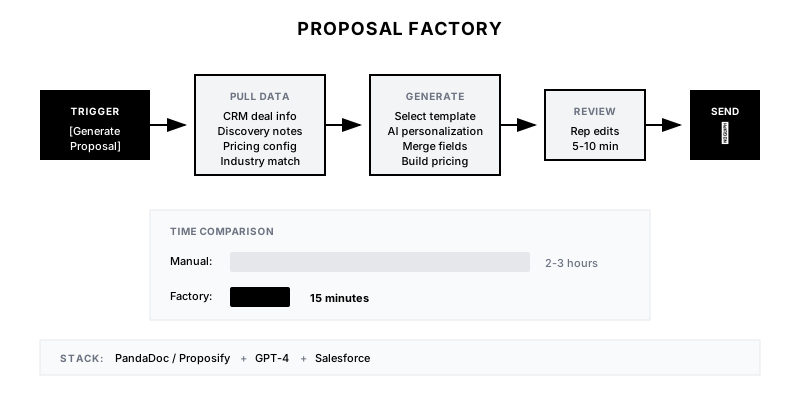
The Proposal Factory automates proposal generation by pulling deal context from CRM, structuring content from templates, and using AI to personalize the narrative. Instead of reps spending 2-3 hours copy-pasting and customizing, they get a 90% complete proposal in minutes that needs only final review.
Why It Matters
Proposal creation is a time sink. Reps cobble together decks, misquote pricing, and miss personalization opportunities. Automation ensures consistency, accuracy, and speed—while AI personalization makes each proposal feel crafted, not templated.
Who It's For
- Account Executives creating multiple proposals weekly
- Sales teams with standardized product/pricing
- Companies with complex proposals requiring multiple sections
- Sales leaders wanting proposal quality consistency
Preconditions
Required Tools
- Proposal software (PandaDoc, Proposify, Qwilr)
- CRM with complete opportunity data
- GPT-4 for content personalization
- Pricing/CPQ system (optional)
- Call recording for discovery context
Required Fields/Properties
- Opportunity: company, contacts, value, products
- Discovery notes or call summary
- Pricing configuration
- Customer pain points/use case
- Implementation timeline
Definitions Required
- Proposal sections and templates
- Pricing rules and approval thresholds
- Personalization points (what AI customizes)
- Review and approval workflow
Step-by-Step Workflow
Build Proposal Templates
Goal: Create modular templates that can be assembled and customized.
Actions:
- Define standard proposal sections
- Create content blocks for each section
- Build conditional logic (show/hide based on deal type)
- Design pricing tables with dynamic population
- Add merge fields for CRM data
Implementation Notes: Templates should be 80% complete with merge fields filling the rest. Build variations for different deal sizes, industries, or product lines.
Automation Logic:
Proposal Template Structure:

1. COVER PAGE
   - {{prospect_company}} logo
   - Prepared for: {{primary_contact}}
   - Prepared by: {{ae_name}}
   - Date: {{proposal_date}}

2. EXECUTIVE SUMMARY [AI-generated]
   - Challenge summary (from discovery)
   - Proposed solution overview
   - Expected outcomes
   - Investment overview

3. ABOUT {{your_company}}
   - Standard company overview
   - Relevant customer logos
   - Industry-specific proof points

4. UNDERSTANDING YOUR NEEDS
   - Pain points identified (from discovery)
   - Current state assessment
   - Desired future state

5. PROPOSED SOLUTION
   - Products/services recommended
   - How each addresses stated needs
   - Implementation approach

6. INVESTMENT [Auto-calculated]
   - Pricing table (from CPQ/CRM)
   - Payment terms
   - ROI projection

7. TIMELINE
   - Implementation milestones
   - Resource requirements

8. NEXT STEPS
   - Call to action
   - Contact information
Configure Data Integration
Goal: Pull deal data automatically from CRM and other sources.
Actions:
- Map CRM fields to proposal merge fields
- Connect pricing/CPQ system
- Pull discovery notes or call transcripts
- Fetch relevant case studies by industry
- Include contact and company details
Implementation Notes: Data quality matters. If CRM fields are empty or wrong, proposals will be wrong. Build validation that flags missing required fields before generation.
Automation Logic:
// Example: CRM to Proposal field mapping
const proposalData = {
  // Company info
  prospect_company: opportunity.Account.Name,
  prospect_logo: opportunity.Account.Logo_URL__c,
  industry: opportunity.Account.Industry,
  company_size: opportunity.Account.NumberOfEmployees,

  // Contact info
  primary_contact: opportunity.Primary_Contact__r.Name,
  contact_title: opportunity.Primary_Contact__r.Title,
  contact_email: opportunity.Primary_Contact__r.Email,

  // Deal info
  deal_value: formatCurrency(opportunity.Amount),
  products: opportunity.OpportunityLineItems,
  close_date: opportunity.CloseDate,

  // Discovery context
  pain_points: opportunity.Pain_Points__c,
  use_case: opportunity.Primary_Use_Case__c,
  success_criteria: opportunity.Success_Criteria__c,

  // Seller info
  ae_name: opportunity.Owner.Name,
  ae_email: opportunity.Owner.Email,
  ae_phone: opportunity.Owner.Phone
};
Implement AI Personalization
Goal: Use AI to generate custom content sections based on deal context.
Actions:
- Identify sections requiring AI generation
- Create prompts for each section type
- Feed discovery context to AI
- Generate executive summary
- Customize solution positioning to pain points
Implementation Notes: AI works best for narrative sections—executive summaries, needs assessments, solution descriptions. Don't use AI for pricing or legal sections.
Automation Logic:
AI Prompt: Executive Summary Generation

Generate a 150-word executive summary for a sales proposal.

Context:
- Prospect: {{prospect_company}} ({{industry}}, {{company_size}} employees)
- Primary Contact: {{primary_contact}}, {{contact_title}}
- Pain Points: {{pain_points}}
- Use Case: {{use_case}}
- Products Proposed: {{products}}
- Deal Value: {{deal_value}}

Discovery Notes:
{{discovery_notes}}

The executive summary should:
1. Reference their specific challenges (use their language from discovery)
2. Position our solution as addressing those challenges
3. Hint at expected outcomes without overpromising
4. Set up the investment as justified by value

Tone: Professional, confident, consultative.
Avoid: Generic claims, superlatives, jargon.
Build Generation Workflow
Goal: Create seamless trigger to generation to delivery process.
Actions:
- Add 'Generate Proposal' button in CRM
- Validate required fields before generation
- Run AI generation for custom sections
- Assemble complete proposal from template
- Create draft in proposal software
Implementation Notes: Generation should take under 2 minutes. If longer, optimize by pre-generating common sections or caching AI responses for similar deals.
Add Review and Approval
Goal: Ensure quality before proposals go to prospects.
Actions:
- Route generated proposals to rep for review
- Flag AI-generated sections for verification
- Add approval workflow for non-standard pricing
- Enable easy editing in proposal tool
- Log review edits for template improvement
Implementation Notes: Generated proposals need review—AI makes mistakes and context can be wrong. Build a quick review step that takes 5-10 minutes, not an hour.
Templates
Proposal Generation Request Form
📝 GENERATE PROPOSAL

**Opportunity:** {{opportunity_name}}
**Company:** {{prospect_company}}
**Value:** {{deal_value}}

**Validation Check:**
{{#if missing_fields}}
⚠️ Missing required fields:
{{#each missing_fields}}
• {{field_name}}
{{/each}}

[Update Opportunity] to continue
{{else}}
✅ All required fields present

**Template:**
( ) Standard Proposal
( ) Enterprise Proposal
( ) Renewal Proposal

**Customization:**
[ ] Include ROI calculator
[ ] Include implementation timeline
[ ] Include case study: {{industry}}

[Generate Proposal]
{{/if}}
AI-Generated Executive Summary Example
EXECUTIVE SUMMARY

{{prospect_company}} is experiencing significant challenges with {{pain_point_1}}, which has resulted in {{business_impact}}. Your team has identified that {{current_state_assessment}} is no longer sustainable as you scale toward {{stated_goal}}.

After our discovery conversations with {{primary_contact}} and the team, we've designed a solution that directly addresses these challenges through {{product_1}} and {{product_2}}. This approach will enable {{prospect_company}} to {{desired_outcome_1}} while {{desired_outcome_2}}.

Based on results from similar {{industry}} companies, we anticipate {{prospect_company}} can achieve {{expected_result}} within {{timeframe}}. The investment of {{deal_value}} represents {{roi_statement}}.

The following proposal outlines our recommended approach, timeline, and investment details.
Pricing Table Template
| Product/Service | Quantity | Unit Price | Total |
|-----------------|----------|------------|-------|
| {{product_1}} | {{qty_1}} | {{price_1}} | {{total_1}} |
| {{product_2}} | {{qty_2}} | {{price_2}} | {{total_2}} |
| Implementation | 1 | {{impl_price}} | {{impl_price}} |
| Training | {{training_hours}} hrs | {{training_rate}} | {{training_total}} |
| **Subtotal** | | | **{{subtotal}}** |
| Discount ({{discount_pct}}%) | | | -{{discount_amount}} |
| **Total Investment** | | | **{{total}}** |
Field Validation Rules
| Field | Required | Fallback | Used In |
|-------|----------|----------|--------|
| Account Name | Yes | - | Cover, Throughout |
| Primary Contact | Yes | - | Cover, Salutation |
| Pain Points | Yes | - | Exec Summary, Needs |
| Products | Yes | - | Solution, Pricing |
| Amount | Yes | - | Pricing, Summary |
| Discovery Notes | Recommended | Generic | Exec Summary |
| Use Case | Recommended | Generic | Solution |
| Industry | Recommended | Generic | Case Studies |
QA + Edge Cases
Test Cases Checklist
- Complete opportunity → proposal generated in <2 minutes
- Missing required fields → validation error with specific guidance
- AI-generated summary → reflects actual discovery notes
- Pricing matches CPQ → no discrepancies in proposal
- Rep reviews and edits → changes logged for template improvement
Common Failure Modes
- Poor data quality: Garbage in, garbage out. If discovery notes are empty, AI can't personalize. Build enforcement at the CRM level.
- Over-reliance on AI: AI-generated content can be wrong or generic. Always require human review before sending.
- Template rigidity: If templates don't allow customization, reps will bypass the system. Balance standardization with flexibility.
- Pricing errors: Wrong pricing in proposals is a credibility killer. Validate pricing against source of truth before generation.
Troubleshooting Tips
- If generation fails: Check CRM field mapping and API connections
- If AI content is generic: Review discovery notes quality; may need better prompts
- If reps bypass the system: Survey for friction points; may need easier workflow
- If proposals need heavy editing: Templates may need updating based on common edits
KPIs and Reporting
KPIs to Track
- Proposal Generation Time: <5 minutes from request to draft
- Edit Time Required: <15 minutes average review/edit time
- Adoption Rate: >90% of proposals created through factory
- Proposal-to-Close Rate: Track conversion rate from proposal sent to won
- Rep Time Saved: 2+ hours saved per proposal vs. manual creation
Suggested Dashboard Widgets
- Proposals Generated: Count of proposals by rep, template, week
- Generation to Send Time: How long from generation to prospect delivery
- Edit Patterns: Which sections get edited most (template improvement signal)
- Win Rate by Template: Which proposal templates perform best