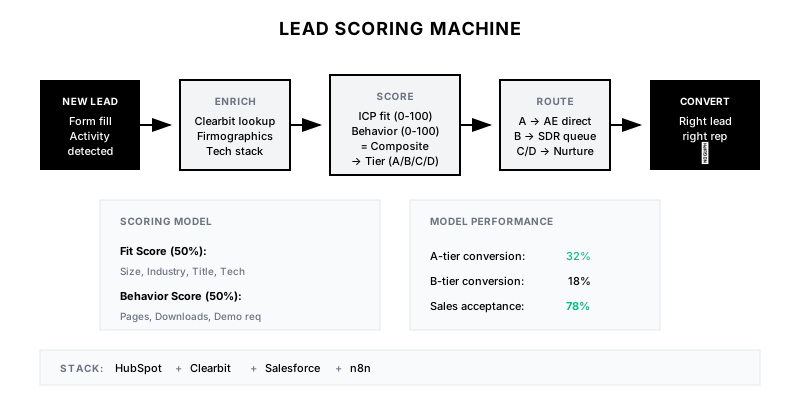
Overview
What It Is
An automated scoring system that evaluates every lead against your ideal customer profile and engagement patterns, producing a prioritized score that determines routing, follow-up urgency, and nurture strategy.
Why It Matters
Not all leads are equal. Sales time is limited—spending it on low-quality leads kills productivity. Scoring ensures your best leads get immediate attention while others are nurtured appropriately.
Who It's For
- Marketing teams optimizing MQL quality
- SDR teams prioritizing outreach
- RevOps building lead management systems
- Sales leaders improving team efficiency
Preconditions
Required Tools
- HubSpot/Marketo (marketing automation)
- Clearbit/ZoomInfo (enrichment)
- Salesforce (CRM)
- n8n/Zapier (orchestration)
Required Fields/Properties
- Company size (employees/revenue)
- Industry
- Job title/function
- Engagement history (pages, downloads, emails)
- Intent signals (pricing page, demo request)
Definitions Required
- Ideal Customer Profile criteria
- MQL threshold score
- Score decay rules
- Routing rules by score tier
Step-by-Step Workflow
Define ICP Scoring Criteria
Goal: Establish demographic and firmographic scoring model
Actions:
- Analyze closed-won customers for common attributes
- Define positive fit criteria (industry, size, tech stack)
- Define negative fit criteria (small companies, wrong industry)
- Assign point values based on correlation with conversion
Implementation Notes: Use actual conversion data to weight criteria. If 'Enterprise' leads convert 3x better than 'SMB', score accordingly.
Define Behavioral Scoring Model
Goal: Score leads based on engagement and intent signals
Actions:
- Identify high-intent behaviors (pricing, demo request)
- Define engagement scoring (content downloads, email opens)
- Set recency weighting (recent activity scores higher)
- Implement score decay for inactive leads
Implementation Notes: Behavioral score should reflect buying intent. Pricing page visit > blog view. Demo request > whitepaper download.
Calculate Composite Score
Goal: Combine fit and behavior into actionable lead score
Actions:
- Weight fit vs. behavior (typically 50/50 or 60/40)
- Calculate composite score
- Assign grade/tier (A/B/C/D or Hot/Warm/Cold)
- Store score and components for analysis
Implementation Notes: Keep fit and behavior visible separately—an A-fit lead with low engagement needs nurturing, while a C-fit lead with high engagement needs qualification.
Configure Real-Time Scoring
Goal: Score leads immediately upon creation or activity
Actions:
- Trigger scoring on new lead creation
- Re-score on significant activity (page view, download, form)
- Update score on enrichment data arrival
- Log score changes for analysis
Implementation Notes: Real-time scoring ensures hot leads don't wait. A lead requesting a demo should be scored and routed within minutes, not hours.
Build Routing Rules
Goal: Route leads to appropriate owners based on score
Actions:
- Define MQL threshold (e.g., score ≥60)
- Set up tier-based routing (A→AE, B→SDR, C/D→nurture)
- Implement round-robin or territory assignment
- Create SLA alerts for unworked high-score leads
Implementation Notes: Hot leads should route immediately to available reps. Consider using real-time notification (Slack) for A-tier leads.
Measure and Optimize Model
Goal: Track scoring accuracy and refine model over time
Actions:
- Track conversion rates by score tier
- Analyze false positives (high score, didn't convert)
- Identify missed opportunities (low score, did convert)
- A/B test scoring changes
Implementation Notes: Lead scoring is never 'done.' Review monthly and adjust weights based on actual conversion data. If B-tier converts better than A-tier, your model needs work.
Templates
Lead Scoring Model Documentation
| Category | Criteria | Points | Rationale |
|----------|----------|--------|----------|
| **Fit - Company Size** | | | |
| | 1-50 employees | -10 | Below ICP, low conversion |
| | 51-200 employees | +15 | Sweet spot for product |
| | 201-1000 employees | +25 | Best conversion rate |
| | 1001-5000 employees | +30 | High value, good fit |
| | 5000+ employees | +20 | Long cycles offset value |
| **Fit - Industry** | | | |
| | SaaS / Technology | +25 | Primary ICP |
| | Financial Services | +20 | Strong vertical |
| | Healthcare | +15 | Growing vertical |
| **Behavior - Intent** | | | |
| | Demo request | +30 | Highest intent |
| | Pricing page view | +20 | Active evaluation |
| | Case study download | +15 | Social proof seeking |
Score Tier Definitions
**Lead Score Tiers**

**A-Tier (Score 80+)**
- Action: Immediate sales follow-up (<1 hour)
- Routing: Direct to AE with Slack alert
- Expected conversion: >30% to opportunity

**B-Tier (Score 60-79)**
- Action: SDR outreach within 24 hours
- Routing: SDR queue with prioritization
- Expected conversion: 15-25% to opportunity

**C-Tier (Score 40-59)**
- Action: Automated nurture sequence
- Routing: Marketing automation
- Expected conversion: 5-10% to opportunity

**D-Tier (Score <40)**
- Action: Long-term nurture only
- Routing: Marketing automation
- Expected conversion: <5% to opportunity
Weekly Scoring Performance Report
📊 *Lead Scoring Performance - Week of {{week}}*

*Leads by Tier:*
| Tier | Count | MQL→SQL | Expected |
|------|-------|---------|----------|
| A | {{a_count}} | {{a_rate}}% | >30% |
| B | {{b_count}} | {{b_rate}}% | 15-25% |
| C | {{c_count}} | {{c_rate}}% | 5-10% |
| D | {{d_count}} | {{d_rate}}% | <5% |

*Model Health Indicators:*
✓ A-tier converts higher than B-tier: {{a_vs_b}}
✓ No tier inversion detected: {{no_inversion}}
✓ Scoring distribution balanced: {{distribution_ok}}

*Recommended Adjustments:*
{{recommendations}}
QA + Edge Cases
Test Cases Checklist
- Verify demo request triggers immediate A-tier scoring
- Test score decay applies correctly after 60 days inactivity
- Confirm MQL status updates at threshold score
- Validate routing rules assign correct owners
- Test negative criteria properly reduce scores
Common Failure Modes
- Score inflation: Too many activities drive everyone to high scores. Cap behavioral score or use logarithmic scaling for repeated activities.
- Enrichment failures: Missing firmographic data leaves fit score incomplete. Default to neutral score for unknown fields, don't penalize.
- Stale scores: Scores not updating on new activity. Verify webhook triggers and check for API rate limiting.
Troubleshooting Tips
- If A-tier converts poorly, review criteria weights against actual conversion data
- For score clustering (everyone is B-tier), widen point spreads between criteria
- If sales rejects MQLs, add their feedback as negative scoring criteria
KPIs and Reporting
KPIs to Track
- MQL-to-SQL Conversion Rate: >25% for A/B-tier combined
- Sales Accepted Lead Rate: >70% of MQLs accepted
- Tier Conversion Monotonicity: A > B > C > D conversion rates
- Score Accuracy: >80% of won opps from A/B leads
Suggested Dashboard Widgets
- Lead Distribution by Tier: Pie chart of current lead inventory by score tier
- Conversion Rate by Tier: Bar chart comparing conversion rates across tiers
- Score Distribution: Histogram of lead scores to check distribution health
- Model Accuracy Over Time: Line chart of predicted vs. actual conversion rates