Overview
What It Is
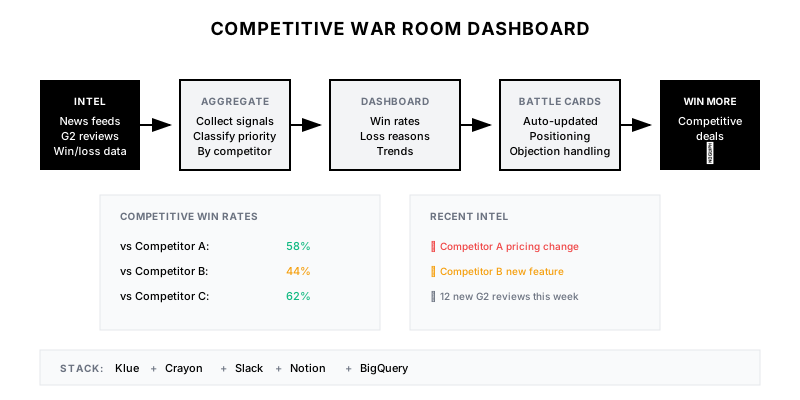
A centralized competitive intelligence dashboard that automatically aggregates news, product updates, review sentiment, win/loss patterns, and sales feedback into actionable battle cards and alerts—giving sales teams an always-current view of the competitive landscape.
Why It Matters
Companies lose 40%+ of competitive deals due to inadequate intelligence. A war room ensures every rep has the latest competitive positioning, knows exactly what to say against each competitor, and learns from wins and losses in real-time.
Who It's For
- Sales reps facing competitive deals
- Product marketing maintaining battle cards
- Sales enablement training on competitive response
- Product teams tracking competitor features
Preconditions
Required Tools
- Klue or Crayon (competitive intel platform)
- Google Alerts or Feedly (news monitoring)
- CRM with competitor field
- Notion or Confluence (battle card hosting)
Required Fields/Properties
- Primary competitor field on opportunities
- Win/loss reason with competitor context
- Competitive mention tracking in calls
- Customer feedback and objections
Definitions Required
- Primary competitors to track (top 5-10)
- Signal sources and priority
- Battle card update cadence
- Alert routing rules
Step-by-Step Workflow
Map Competitors and Data Sources
Goal: Identify what to track and where data lives
Actions:
- List top 5-10 competitors by deal frequency
- Identify news sources per competitor
- Set up Google Alerts for each competitor
- Configure G2/Capterra review monitoring
- Map CRM competitive fields
Implementation Notes: Start with competitors you lose to most often. Quality of sources matters more than quantity. Include LinkedIn, job boards, and SEC filings for enterprise competitors.
Build Intelligence Aggregation Pipeline
Goal: Automate collection of competitive signals
Actions:
- Set up RSS feed aggregation
- Create web scraper for competitor sites
- Integrate G2 review API
- Pull LinkedIn job postings via API
- Aggregate CRM win/loss data
Implementation Notes: Use a tool like Klue or Crayon for managed collection. If building custom, use n8n or Zapier for orchestration. Run collection daily to balance freshness with cost.
Build the War Room Dashboard
Goal: Create visual competitive intelligence hub
Actions:
- Design dashboard layout by competitor
- Add real-time news feed section
- Build win/loss analysis charts
- Create positioning strength matrix
- Link to battle cards from dashboard
Implementation Notes: Dashboard should answer: How are we doing against this competitor? What's new? What should I say? Use Looker, Tableau, or a custom React dashboard.
Create Dynamic Battle Cards
Goal: Build always-current competitive positioning docs
Actions:
- Design battle card template
- Auto-populate with win/loss insights
- Add objection handling per competitor
- Include feature comparison matrix
- Link proof points and case studies
Implementation Notes: Battle cards should be scannable in 30 seconds. Lead with 'what to say' not just information. Update automatically when new signals arrive.
Set Up Alert System
Goal: Push critical competitive intel to right people
Actions:
- Define alert priority levels
- Route alerts by competitor and type
- Create Slack integration for real-time alerts
- Build email digest for weekly summary
- Add alert to CRM when competitor mentioned
Implementation Notes: Not every signal warrants an alert. Use AI to classify importance. Route product news to product team, pricing changes to sales leadership.
Integrate Win/Loss Analysis
Goal: Feed deal outcomes back into intelligence
Actions:
- Capture competitor on every closed deal
- Implement structured win/loss surveys
- Aggregate feedback into patterns
- Auto-update battle cards with insights
- Track competitive win rate trends
Implementation Notes: Win/loss data is the most valuable competitive intel. Make it easy for reps to provide feedback. Use AI to extract themes from free-text responses.
Templates
Competitive Win Rate Dashboard
| Competitor | Deals (90d) | Win Rate | Avg Deal Size | Top Loss Reason | Trend |
|------------|-------------|----------|---------------|-----------------|-------|
| Competitor A | 45 | 58% | $42K | Price | +5% |
| Competitor B | 32 | 44% | $38K | Features | -3% |
| Competitor C | 28 | 62% | $51K | Support | +8% |
| No Competitor | 89 | 71% | $35K | - | +2% |
Alert Priority Matrix
| Signal Type | Critical | High | Medium | Low |
|-------------|----------|------|--------|-----|
| Pricing change | Immediate Slack | - | - | - |
| Product launch | Immediate Slack | - | - | - |
| Funding/M&A | Immediate Slack | - | - | - |
| Executive hire | - | Same-day email | - | - |
| Feature release | - | Same-day email | - | - |
| Blog post | - | - | Weekly digest | - |
| Review (negative) | - | Same-day email | - | - |
| Review (positive) | - | - | - | Weekly digest |
| Job posting | - | - | Weekly digest | - |
Win/Loss Survey Template
**Deal: {Opportunity Name}**
**Outcome: {Won/Lost}**
**Competitor: {Competitor Name}**

1. What was the primary reason for the {win/loss}?
   [ ] Price/Value
   [ ] Product Capabilities
   [ ] Existing Relationship
   [ ] Implementation/Support
   [ ] Integration Requirements
   [ ] Security/Compliance
   [ ] Other: ___

2. What specific capabilities did they cite when choosing {us/competitor}?
   _______________

3. What objections were hardest to overcome?
   _______________

4. Who was the primary decision maker and what did they care most about?
   _______________

5. Any intel on competitor pricing or approach?
   _______________

6. What would have changed the outcome?
   _______________
QA + Edge Cases
Test Cases Checklist
- Verify news alerts fire within 1 hour of publication
- Test battle card auto-updates with new intel
- Confirm win/loss data flows to competitor metrics
- Validate alert routing reaches correct channels
- Test dashboard loads with current data
Common Failure Modes
- Stale battle cards: Cards not updated with new intel. Automate updates and show 'last updated' prominently.
- Alert overload: Too many low-priority alerts. Implement smarter classification and user preferences.
- Incomplete win/loss data: Reps skip surveys. Make it 2 clicks, integrate into deal close workflow.
Troubleshooting Tips
- If intel is stale, check RSS feeds and scraper configurations
- For missing competitors, audit CRM data quality
- If reps don't use battle cards, embed in sales workflow tools
KPIs and Reporting
KPIs to Track
- Competitive Win Rate: >55% vs primary competitors
- Battle Card Views: >50 views per card per month
- Win/Loss Survey Completion: >80% of competitive deals
- Intel Freshness: Battle cards updated within 48h of major news
Suggested Dashboard Widgets
- Win Rate by Competitor: Trend of win rates vs each competitor
- Recent Intel Feed: Latest signals across all competitors
- Loss Reason Analysis: Why we lose by competitor
- Battle Card Usage: Views and engagement per card