
Artificial intelligence for operational excellence is crucial in today’s competitive business world. It marks a significant step in corporate growth strategies. With the fast pace of technological change, using AI for operational excellence boosts company efficiency. It’s key to keeping ahead in the market. AI optimizations make operations smoother, leading to smarter and more precise processes.
Key Takeaways
- Embracing AI revolutionizes process efficiencies, fostering a new realm of operational excellence.
- AI’s predictive maintenance capabilities can lead to a remarkable 10% reduction in downtime.
- Improving quality control with AI can yield up to 12% better product quality outcomes.
- Productivity can be amplified by up to 30% through strategic deployment of AI in maintenance and production processes.
- Enterprises should prioritize sound data management to reap the full benefits of AI in operations.
- For successful AI integration, businesses must navigate complex system compatibility, regulatory compliance, and employee skill enhancement.
The Role of Artificial Intelligence in Achieving Operational Excellence
Artificial Intelligence (AI) is changing how industries work. It’s enhancing operations with AI technology, driving efficiency with AI solutions, and maximizing productivity with artificial intelligence. By using AI, companies are making their processes smoother. They are also seeing big improvements in their performance across different areas.
- Zest AI dramatically improved financial inclusivity by increasing loan approval rates by 20% for minority borrowers using machine learning to ensure low default rates.
- Amazon optimized its inventory management and enhanced delivery times by employing predictive AI algorithms, achieving a 20% reduction in inventory costs.
- In healthcare, PathAI enhanced disease detection rates by 30% through advanced AI analysis, significantly contributing to timely and accurate diagnoses.
- IBM’s Watson has been pivotal in oncology, where it provides cancer treatment recommendations with an accuracy of 88%, improving patient outcomes significantly.
- Manufacturing giants like Siemens and Element AI have seen productivity boosts of 20% and efficiency improvements, respectively, by incorporating AI-driven automation and maintenance technologies.
- Unilever and Toyota have leveraged AI to refine marketing strategies and streamline production processes, seeing enhancements of 30% in engagement and a 50% reduction in production lead times.
AI isn’t just an upgrade in technology. It’s a game-changer for businesses wanting to succeed in a tough market. By adopting AI, companies are seeing big benefits. This shows how vital good infrastructure and ongoing learning are when adding new technology.
As companies see the benefits of maximizing productivity with artificial intelligence, AI’s importance is growing. It’s helping with economic and efficiency improvements across many industries. This shows how AI tools are becoming key in making better decisions and being more agile.
The Impact of Predictive Maintenance on Industry Operations
Predictive maintenance has revolutionized industry operations. It uses AI to foresee and stop equipment failures before they halt production. This not only makes operations smoother but also shows the power of optimizing performance with artificial intelligence. It’s a game-changer for how companies handle maintenance.
Reactive vs. Proactive Maintenance: A Shift in Approach
Before, industries would fix things only after they broke. Now, with AI, there’s a big change to proactive maintenance. This method analyzes data in real time to predict breakdowns. It helps avoid costly stops in production and boosts operational excellence through AI implementation.
Real-Time Analysis and Early Malfunction Recognition
Industries now monitor equipment with sensors and AI algorithms. This is key in manufacturing, where small issues can cause big losses. AI tools play a part by looking through data from industrial activities. They make it easier to spot and fix problems early.
Cost-Savings and Increased Machinery Life Expectancy
Using AI in predictive maintenance cuts costs tied to sudden machine failures. It also makes equipment last longer. This means fewer breakdowns and more savings, showing how AI leads to smarter, cheaper manufacturing.
Plus, the table below highlights how AI-driven maintenance makes things better:
| Improvement Area | Benefit |
|---|---|
| Equipment Reliability | Enhanced through continuous health monitoring |
| Operational Downtime | Significantly reduced |
| Maintenance Costs | Decreased due to preemptive action |
| Safety | Improved by avoiding potential hazards |
| Environmental Impact | Reduced waste from machine breakdowns |
This predictive, data-driven method helps keep operations smooth. It puts companies ahead in the fast-changing industry world. By adding AI to maintenance, businesses aren’t just repairing machines. They’re leading industry changes and creating new standards for how things are done.
Optimizing Business Processes Through AI Solutions
AI solutions are changing how businesses improve their processes, especially in Business Process Automation (BPA). By using the latest AI, companies are boosting productivity and setting new standards in efficiency. They are becoming more agile in their operations too.
Intelligent Process Automation (IPA) leads this change. It makes traditional BPA systems smarter by learning from data. AI helps in refining processes, finding errors, and managing complex data like emails and social media.
- AI-powered Natural Language Processing (NLP) automates documentation, analyzes emotions in customer communications, and classifies content efficiently.
- Computer Vision is used to improve quality control, automate invoice processing, and enhance security with facial recognition.
- Utilizing Robotic Process Automation (RPA) streamlines data entry, transaction processing, and compliance reporting. This optimizes regulatory practices and keeps operations precise.
- Machine Learning predicts equipment failures, optimizes supply chains, and aids in detecting fraud in finance and accounting.
- Speech Recognition allows more dynamic interactions with business applications and automatic transcription of meetings.
With the AI market expected to surge by 36.6% between 2024 and 2030, more companies are using AI. They aim to reduce the workload on humans, speed up R&D, and make precise decisions through data analysis.
| AI Technology | Function | Impact |
|---|---|---|
| Natural Language Processing (NLP) | Document Automation, Sentiment Analysis | Enhances efficiency in customer service and content management |
| Computer Vision | Quality Control, Security Enhancement | Improves accuracy and security in process management |
| Robotic Process Automation (RPA) | Data Entry, Compliance Reporting | Reduces errors and streamlines compliance |
| Machine Learning | Predictive Maintenance, Fraud Detection | Boosts operational readiness and financial security |
| Speech Recognition | Interactive Applications, Automated Transcription | Facilitates better communication and documentation processes |
As companies face more challenges, AI’s scalability helps them grow without big increases in costs. This enhances productivity and promotes ongoing innovation and development.
Artificial Intelligence’s Transformation of Quality Control
Industries are moving towards operational excellence through AI implementation. This shift has changed how we control quality in manufacturing. AI not only optimizes performance but also brings new capabilities to traditional production.
Enhancing operational standards with AI is key in quality control. It automates complex tasks and enables decisions to be made in real-time. This makes production flawless and highly efficient.
Advanced Image Recognition for Flawless Production
With AI-based image recognition, factories can spot tiny defects that humans might miss. This precision, powered by intelligent algorithms, lowers errors and keeps product quality high. It is crucial in industries like pharmaceuticals and electronics, where perfection is critical.
Automation Leading to Consistent Product Excellence
AI-driven automation ensures standardized production processes. This approach doesn’t just replicate results. It uses AI to maintain high quality across all products.
Companies such as Siemens and Boeing have led in adopting AI in manufacturing. They have seen better product consistency and fewer defects with AI.
The operational excellence through AI implementation allows firms to manage data more accurately. This means less downtime and quicker production cycles.
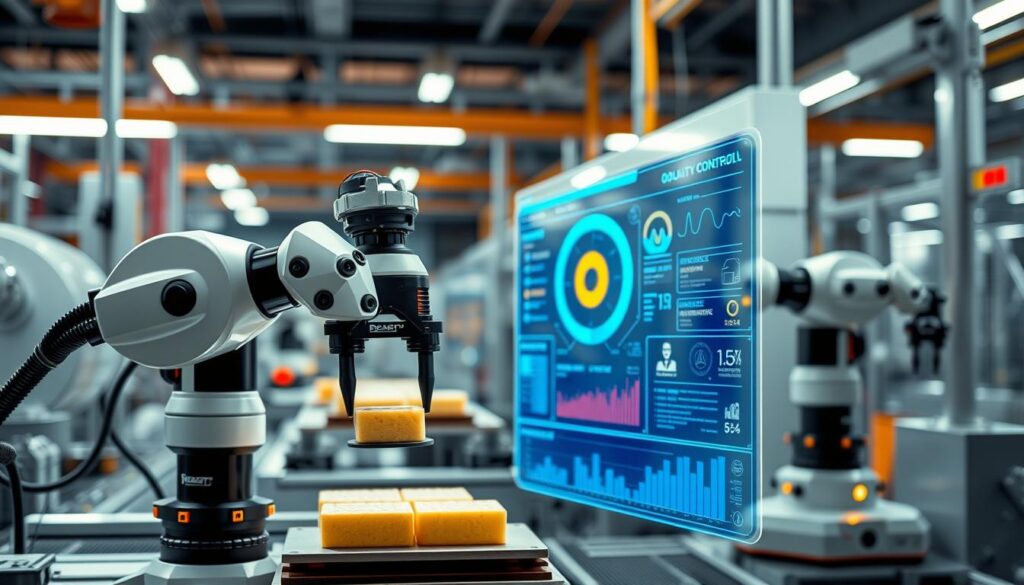
AI brings benefits to quality management, but firms must overcome certain challenges. Issues like poor data quality and lack of AI experts are significant. Solutions include investment in training, better data collection, and gradually integrating AI.
Using AI for optimizing performance involves predictive analytics too. This approach predicts production flaws before they happen. It ensures efficiency now and prepares for future improvements.
Adopting AI for quality control can transform manufacturing. It leads to data-driven decisions and superior products. This gives companies a competitive edge and meets consumer demands with precision.
| Feature | Benefit | Industry Example |
|---|---|---|
| Advanced Image Recognition | Precision in defect detection | Electronics, Pharmaceuticals |
| Automated Quality Control Systems | Consistent product quality | Automotive, Aerospace |
| Real-time Data Analysis | Reduced downtime, Faster production | Consumer Goods, Heavy Machinery |
Implementing Intelligent Decision Support Systems for Strategic Planning
Intelligent Decision Support Systems (IDSS), powered by AI, are essential for companies seeking operational excellence. These systems use AI to analyze big datasets. This helps in making smart decisions for strategic planning.
By 2031, the decision intelligence market could hit $39.3 billion, growing annually by 15.2%. This shows how vital AI is for improving business operations. By 2024, 75% of businesses plan to fully use AI, showing its importance in staying competitive.
IDSS isn’t just about handling data. It also offers tailored suggestions based on business and market insights. For example, AI forecasts market trends, improves stock levels, and betters customer service strategies.
AI-driven IDSS automate routine work, prioritize important tasks, and improve resource use. These actions help companies be more nimble and ready for market changes.
Adding AI to decision support systems means integrating it smoothly with current tech setups. As sources on AI decision-making show, this should be done without causing issues, ensuring tech upgrades work well.
With more AI in decision-making, ethical and privacy issues come up. Handling these carefully is crucial to keep trust and follow rules. Making sure data is safe and AI choices are fair is key to using AI well.
For firms wanting to lead in innovation and efficiency, investing in AI-driven IDSS is a must. It’s a big decision that can set them apart in their industry and ensure their success.
Enabling a High-Performance Workforce with Robotic Process Automation
Robotic Process Automation (RPA) is changing how businesses work by driving efficiency with AI solutions. It helps build a powerful workforce. RPA automates simple, rule-based tasks. This saves employees’ time, boosts productivity, and lowers mistakes.
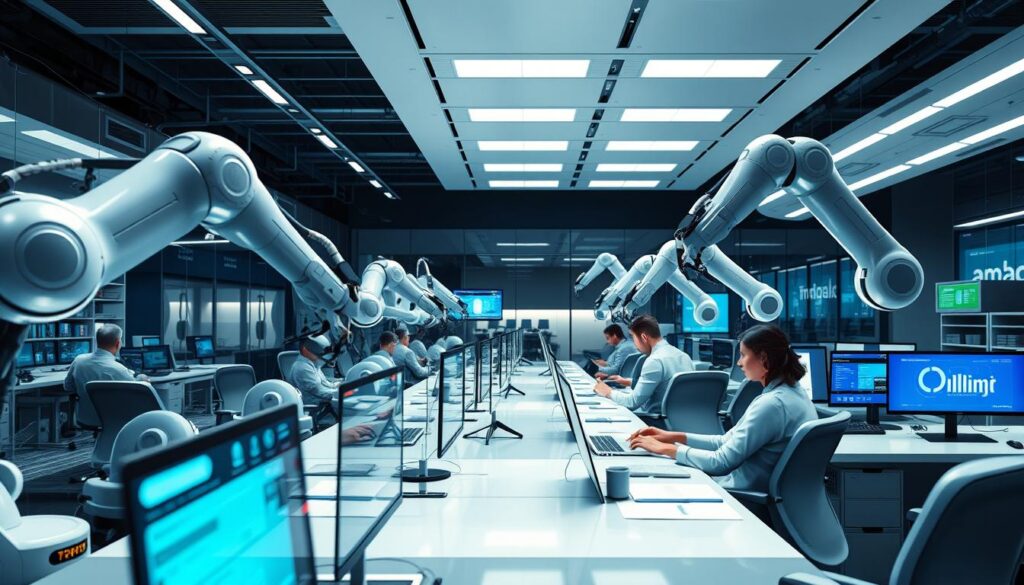
RPA makes a big impact. It lets employees focus on more important, thinking-heavy tasks. This shift is key to creating a lively work setting. It hugely boosts how well operations run.
Setting up robotic process automation is easier than other software. It has easy-to-use interfaces that need little coding knowledge. This makes it faster for companies to start using automation and see its benefits.
- Task automation
- Application integration
- Data manipulation
- Workflow automation
- Rule-based decision making
Predictive analytics are important in advanced RPA systems. They come with driving efficiency with AI solutions. This leads to smarter decisions and better use of resources. This makes businesses run more efficiently.
The use of RPA is growing as fields aim for more innovation. Adding it to AI and ML starts a move towards smart automation. It mixes solid robotic process automation with top analytic skills.
Looking forward, RPA will grow in its reach and how it’s used. It will also start working with cloud and SaaS solutions. This will lead to a business setting that’s highly adaptable and well-connected.
Conclusion
The way companies excel is changing because of artificial intelligence (AI). McKinsey & Company found that AI boosts productivity by up to 40%. Amazon saw a 30% increase in efficiency in 2022 due to AI. Plus, PwC thinks AI could add $15.7 trillion to the world’s economy by 2030.
Using AI to improve operations is completely changing how industries work. For example, the healthcare sector saw a 30% drop in diagnostic mistakes thanks to AI, Mayo Clinic reports. The growth of robotic process automation also shows a big move towards automation, expected to reach $2.9 billion by 2025 according to Gartner.
Getting the full benefit of AI requires constant learning and adjusting. Companies like General Electric and Wells Fargo are leading the way by developing clear AI strategies. Machine learning and predictive analytics are setting new standards for efficiency. By adopting AI, businesses are moving towards major success and leadership in a very competitive field.
FAQ
How does artificial intelligence contribute to operational excellence?
AI improves operational excellence by making processes more efficient and providing insights. Companies gain big productivity increases. This helps them perform better and stay ahead in the market.
What role does AI play in predictive maintenance?
AI is key in predictive maintenance as it analyzes data from sensors. It predicts equipment failures before they happen. This reduces downtime, saves money on repairs, and makes machinery last longer.
How does AI optimize business processes?
AI uses machine learning to optimize logistics and schedules in real time. It adjusts to changes, uses resources well, and boosts productivity in organizations.
What advancements has AI brought to quality control?
AI improves quality control with AI-powered image recognition. It finds defects faster and more accurately than humans. This makes sure products meet high quality standards consistently.
How do intelligent decision support systems assist with strategic planning?
Intelligent systems analyze data to offer insights and forecasts. They help create strong strategies and use resources well. This keeps companies ahead of trends, aiding operational excellence.
What is the significance of Robotic Process Automation in the workforce?
RPA boosts workforce performance by automating basic tasks. It lets employees focus on strategic work. This increases productivity, lowers errors, and creates a better work environment.
How are AI solutions driving efficiency in various sectors?
AI solutions increase efficiency in manufacturing, healthcare, and finance. They help companies streamline operations, cut costs, and provide better services and products.
What can businesses expect from integrating AI into their operations?
Integrating AI promises more efficiency, lower costs, and better decision-making. AI’s ability to learn and adapt helps businesses quickly meet market and customer demands.
Is operational excellence through AI implementation suitable for all types of businesses?
AI can benefit many businesses, but how it’s used varies. The impact depends on the industry, company size, and current processes. Businesses should consider how AI meets their specific needs.