Overview
What It Is
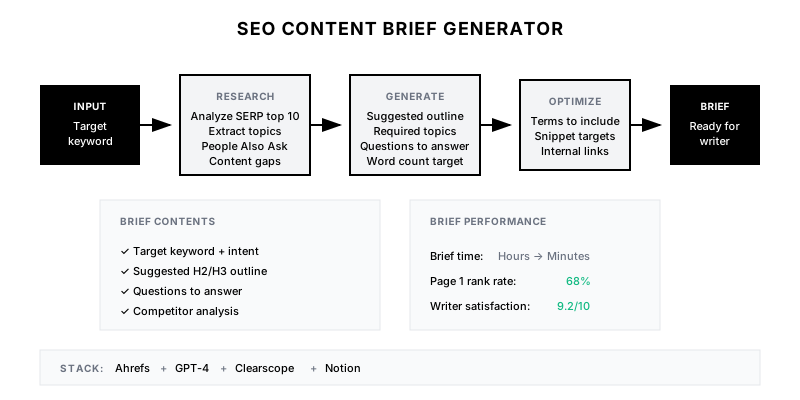
The SEO Content Brief Generator automates the research-intensive process of creating content briefs. Given a target keyword, it analyzes top-ranking content, extracts key topics and questions, and generates a comprehensive brief that gives writers clear direction for creating content that ranks.
Why It Matters
Great content starts with great briefs. But SEO research is time-consuming—analyzing competitors, identifying questions, mapping topic coverage. Automation reduces brief creation from hours to minutes while improving consistency and completeness.
Who It's For
- Content teams producing SEO-focused articles
- SEO managers scaling content production
- Marketing leaders managing freelance writers
- Agencies producing content for clients
Preconditions
Required Tools
- SEO tool (Ahrefs, SEMrush, Moz)
- Content optimization (Clearscope, SurferSEO)
- GPT-4 for analysis and generation
- Content management system
- SERP API for live data
Required Fields/Properties
- Target keyword
- Search intent (informational, transactional, etc.)
- Content type (blog, pillar page, comparison)
- Target word count range
- Internal linking targets
Definitions Required
- Brief template structure
- Minimum SERP analysis depth
- Topic coverage requirements
- Quality standards for briefs
- Workflow from brief to publish
Step-by-Step Workflow
Analyze SERP and Competition
Goal: Understand what's currently ranking for the target keyword.
Actions:
- Pull top 10 organic results for keyword
- Extract content structure from top results
- Identify common topics and subtopics
- Analyze content length and format
- Note featured snippets and SERP features
Implementation Notes: The SERP tells you what Google thinks searchers want. If all top results are long-form guides, don't write a 500-word post. Match intent and format of what's ranking.
Automation Logic:
// Example: SERP analysis pipeline
const analyzeSERP = async (keyword) => {
  // Get top 10 organic results
  const serp = await ahrefs.getSERP(keyword, { limit: 10 });

  // Extract content from each
  const analyses = await Promise.all(
    serp.results.map(async (result) => {
      const content = await scrapeContent(result.url);
      return {
        url: result.url,
        title: result.title,
        wordCount: content.wordCount,
        headers: extractHeaders(content),
        topics: await extractTopics(content),
        questions: extractQuestions(content)
      };
    })
  );

  // Aggregate insights
  return {
    avgWordCount: average(analyses.map(a => a.wordCount)),
    commonTopics: findCommonTopics(analyses),
    commonQuestions: findCommonQuestions(analyses),
    contentFormats: categorizeFormats(analyses),
    featuredSnippet: serp.featured_snippet
  };
};
Extract Questions and Topics
Goal: Identify all questions and subtopics to cover.
Actions:
- Pull 'People Also Ask' questions
- Extract questions from top-ranking content
- Identify related keywords and topics
- Map topic clusters and relationships
- Note gaps in current top content
Implementation Notes: Questions reveal search intent. 'People Also Ask' and related searches show what else users want to know. Comprehensive topic coverage signals expertise to Google.
Automation Logic:
Question Extraction Sources:

1. PEOPLE ALSO ASK
   - Direct from SERP API
   - Expand to get nested questions
   - Prioritize questions with your keyword

2. TOP CONTENT ANALYSIS
   - H2/H3 headers phrased as questions
   - FAQ sections
   - Questions in body content

3. KEYWORD RESEARCH
   - Question modifiers (how, what, why, when)
   - Related searches
   - Long-tail variations

4. COMMUNITY SOURCES
   - Reddit threads on topic
   - Quora questions
   - Forum discussions
   - Social media conversations

Prioritization:
- High: Exact keyword questions
- Medium: Related topic questions
- Low: Tangential questions (include if space)
Generate Content Brief
Goal: Create comprehensive brief for writers.
Actions:
- Generate suggested outline from SERP analysis
- Set word count and format requirements
- List required topics and questions to cover
- Include competitor references
- Add internal and external linking guidance
Implementation Notes: A good brief is specific enough to guide but flexible enough to allow creativity. Include 'must cover' topics and 'nice to have' elements. Don't dictate every word.
Automation Logic:
GPT-4 Brief Generation Prompt:

Generate a comprehensive SEO content brief for this keyword.

Keyword: {{keyword}}
Search Volume: {{volume}}
Keyword Difficulty: {{difficulty}}
Search Intent: {{intent}}

SERP Analysis:
{{serp_analysis}}

Generate a brief that includes:

1. CONTENT GOAL
   - Primary keyword and search intent
   - What success looks like (ranking, traffic)

2. AUDIENCE
   - Who is searching this?
   - What do they already know?
   - What action should they take after reading?

3. CONTENT REQUIREMENTS
   - Recommended word count: {{word_count_range}}
   - Content format: {{format}}
   - Tone: {{tone}}

4. SUGGESTED OUTLINE
   - Generate H2s that cover all key topics
   - Include H3s for detailed sections
   - Note where to include specific elements

5. TOPICS TO COVER (Required)
   - List all topics from SERP analysis that must be covered

6. QUESTIONS TO ANSWER
   - People Also Ask questions
   - Questions from competitor content

7. OPTIMIZATION GUIDANCE
   - Target terms to include naturally
   - Featured snippet opportunity notes
   - Internal link targets

8. COMPETITOR REFERENCE
   - Top 3 URLs for reference
   - What they do well
   - Gaps to exploit
Add Optimization Guidance
Goal: Include specific SEO requirements for the writer.
Actions:
- Generate list of terms to include (from Clearscope/Surfer)
- Note featured snippet opportunities
- Identify internal linking opportunities
- Suggest image and media requirements
- Include schema markup recommendations
Implementation Notes: Integration with Clearscope or SurferSEO adds precision. Their NLP analysis shows exactly which terms top content uses. Writers can check their draft against these targets.
Deliver and Track
Goal: Get briefs to writers and track content performance.
Actions:
- Publish brief to content management system
- Assign to writer with deadline
- Track brief-to-draft-to-publish timeline
- Monitor content ranking after publish
- Iterate on brief quality based on results
Implementation Notes: Close the loop. Track which briefs lead to ranking content. If certain brief elements correlate with success, emphasize those. Continuous improvement.
Templates
SEO Content Brief Template
# Content Brief: {{keyword}}

**Created:** {{date}}
**Assigned to:** {{writer}}
**Due:** {{deadline}}

---

## 🎯 Content Goal

**Primary Keyword:** {{keyword}}
**Search Volume:** {{volume}} monthly
**Difficulty:** {{difficulty}}/100
**Intent:** {{intent}}

**Success Criteria:**
- Rank on page 1 within 90 days
- Generate {{traffic_target}} organic visits/month

---

## 👤 Audience

**Who is searching:**
{{audience_description}}

**What they know:**
{{knowledge_level}}

**What they need:**
{{user_need}}

---

## 📝 Requirements

- **Word Count:** {{min_words}} - {{max_words}} words
- **Format:** {{format}}
- **Tone:** {{tone}}
- **Visuals:** {{visual_requirements}}

---

## 📑 Suggested Outline

{{outline}}

---

## ✅ Must Cover Topics

{{#each required_topics}}
- [ ] {{topic}}
{{/each}}

---

## ❓ Questions to Answer

{{#each questions}}
- {{question}}
{{/each}}

---

## 🔗 Linking

**Internal Links (include these):**
{{#each internal_links}}
- [{{anchor}}]({{url}})
{{/each}}

**External Reference:**
- Link to authoritative sources for statistics
- Cite original research where applicable

---

## 🏆 Competitor Reference

{{#each competitors}}
**{{rank}}. {{title}}**
URL: {{url}}
Word Count: {{word_count}}
Strengths: {{strengths}}
Gaps: {{gaps}}

{{/each}}

---

## 🔍 SEO Optimization

**Terms to include naturally:**
{{optimization_terms}}

**Featured Snippet Opportunity:**
{{snippet_opportunity}}

**Schema:**
{{schema_recommendation}}
Brief Request Form
## New Content Brief Request

**Requested by:** [Name]
**Date:** [Date]

### Keyword Information

**Primary Keyword:**
**Secondary Keywords (optional):**

### Content Details

**Content Type:**
[ ] Blog Post
[ ] Pillar Page
[ ] Product Comparison
[ ] How-To Guide
[ ] Listicle
[ ] Other: _______

**Target Audience:**

**Business Goal:**
[ ] Traffic / Awareness
[ ] Lead Generation
[ ] Product Education
[ ] Thought Leadership

### Additional Context

**Related Content to Link:**

**Competing Content from Us:**

**Special Requirements:**

---

*Brief will be generated within 24 hours*
Brief Performance Report
| Keyword | Brief Date | Publish Date | Current Rank | Target Rank | Traffic | Status |
|---------|------------|--------------|--------------|-------------|---------|--------|
| sales automation software | Nov 1 | Nov 15 | 8 | Top 5 | 1,200 | On track |
| revenue operations guide | Nov 5 | Nov 22 | 14 | Top 10 | 450 | Needs optimization |
| crm integration best practices | Nov 10 | Nov 28 | 3 | Top 5 | 2,100 | Success |
| pipeline management tips | Nov 12 | Dec 5 | 22 | Top 10 | 180 | Monitor |
SERP Analysis Summary
## SERP Analysis: {{keyword}}

**Analysis Date:** {{date}}

### Overview

- **Average Word Count:** {{avg_word_count}}
- **Content Format:** {{dominant_format}}
- **Featured Snippet:** {{snippet_type}} ({{snippet_holder}})
- **SERP Features:** {{serp_features}}

### Top 5 Results

| Rank | Title | Domain | Words | DA |
|------|-------|--------|-------|----|
{{#each top_5}}
| {{rank}} | {{title}} | {{domain}} | {{words}} | {{da}} |
{{/each}}

### Common Topics Covered

{{#each common_topics}}
- {{topic}} ({{coverage}}% of top 10)
{{/each}}

### Content Gaps (Opportunity)

{{#each content_gaps}}
- {{gap}}
{{/each}}

### Questions Asked

{{#each questions}}
- {{question}}
{{/each}}
QA + Edge Cases
Test Cases Checklist
- Keyword submitted → brief generated within 2 hours
- Brief includes SERP analysis → top 10 competitors analyzed
- Questions extracted → People Also Ask included
- Outline generated → covers all identified topics
- Brief assigned → writer notified with deadline
Common Failure Modes
- Stale SERP data: Using outdated competitor analysis. Run fresh SERP analysis for each brief.
- Over-specified briefs: Briefs so detailed they constrain writers. Balance guidance with creative freedom.
- Missing intent: Brief doesn't match search intent. Always verify intent before generating outline.
- No performance tracking: Briefs created without follow-up. Track ranking performance to improve brief quality.
Troubleshooting Tips
- If content doesn't rank: Review brief completeness, may be missing key topics
- If writers struggle: Brief may be too technical, add more context and examples
- If briefs take too long: Streamline SERP scraping, cache common data
- If topics are wrong: Verify search intent, may need manual review step
KPIs and Reporting
KPIs to Track
- Brief-to-Rank Rate: >60% of content reaches page 1 within 90 days
- Time to Brief: Briefs delivered within 24 hours of request
- Writer Satisfaction: >8/10 rating from writers on brief quality
- Organic Traffic Growth: Track traffic from brief-driven content
- Content Velocity: Briefs enable X pieces of content per month
Suggested Dashboard Widgets
- Brief Pipeline: Requested → In Progress → Delivered
- Content Performance: Ranking trajectory of brief-driven content
- Keyword Coverage: Target keywords with content vs. gaps
- Writer Queue: Briefs assigned and deadlines