Overview
What It Is
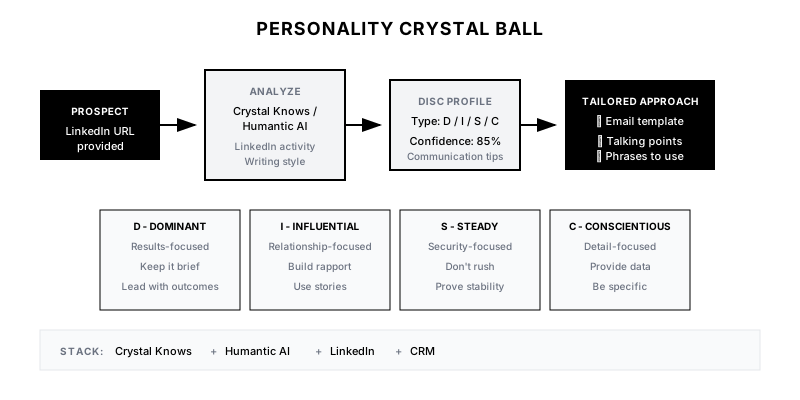
The Personality Crystal Ball uses AI-powered personality analysis tools to predict a prospect's communication preferences before you interact. By analyzing their LinkedIn activity, writing style, and public content, you can anticipate whether they prefer data, stories, quick conversations, or relationship building.
Why It Matters
Mismatched communication styles kill deals. Sending a long, relationship-building email to a direct, results-focused executive gets ignored. Leading with data when someone wants vision falls flat. Personality intelligence lets you mirror preferences from the first touchpoint.
Who It's For
- Enterprise sales reps targeting C-suite buyers
- SDRs personalizing outbound at scale
- Account Executives preparing for discovery calls
- Customer Success managers handling renewal conversations
Preconditions
Required Tools
- Crystal Knows or Humantic AI
- LinkedIn Sales Navigator (for profile access)
- CRM for storing personality data
- GPT-4 for custom analysis (optional)
- Clay for enrichment orchestration
Required Fields/Properties
- Prospect LinkedIn URL
- Prospect email (for Crystal Knows matching)
- Role/title for context
- Interaction type (email, call, meeting)
Definitions Required
- Personality framework to use (DISC, Big Five, custom)
- How personality insights map to communication tactics
- Minimum confidence threshold for recommendations
- When to override AI recommendations with human judgment
Step-by-Step Workflow
Set Up Personality Analysis Tool
Goal: Configure Crystal Knows or Humantic AI for automated analysis.
Actions:
- Create account and configure API access
- Set up LinkedIn profile scraping permissions
- Configure CRM integration for profile storage
- Test analysis accuracy with known contacts
- Define output format for sales team consumption
Implementation Notes: Crystal Knows is great for DISC-based analysis. Humantic AI offers deeper behavioral predictions. Both work well—choose based on your team's familiarity with personality frameworks.
Build Analysis Workflow
Goal: Automate personality analysis when prospects enter the pipeline.
Actions:
- Trigger analysis when new prospect is added
- Pull LinkedIn URL from CRM or enrichment
- Run personality analysis API call
- Store results in CRM custom fields
- Flag low-confidence results for manual review
Implementation Notes: Run analysis in batch for existing prospects or real-time for new ones. Cache results to avoid hitting API limits and speed up retrieval.
Automation Logic:
// Example: Crystal Knows API integration
const analyzePersonality = async (linkedinUrl) => {
  const response = await fetch('https://api.crystalknows.com/v1/profiles', {
    method: 'POST',
    headers: {
      'Authorization': `Bearer ${CRYSTAL_API_KEY}`,
      'Content-Type': 'application/json'
    },
    body: JSON.stringify({ linkedin_url: linkedinUrl })
  });

  const profile = await response.json();
  return {
    disc_type: profile.disc_type,
    communication_style: profile.recommendations.communication,
    phrases_to_use: profile.recommendations.phrases,
    phrases_to_avoid: profile.recommendations.avoid
  };
};
Create Communication Playbooks by Type
Goal: Map personality types to specific communication approaches.
Actions:
- Define email templates for each personality type
- Create call scripts adapted by communication style
- Build discovery question variations
- Document objection handling by personality
- Train team on reading and applying insights
Implementation Notes: Don't overcomplicate—4 main types (DISC) is usually enough. The goal is directional guidance, not psychological profiling. 'This person probably prefers direct communication' is actionable.
Automation Logic:
Communication Playbook by DISC Type:

D (Dominant) - Results-focused
• Lead with bottom line and outcomes
• Keep emails short (<100 words)
• Skip small talk, get to the point
• Example: "Cut your sales cycle by 30%. Quick call?"

I (Influential) - Relationship-focused
• Lead with vision and possibilities
• Use storytelling and enthusiasm
• Mention mutual connections
• Example: "Love what you're building at [Company]..."

S (Steady) - Security-focused
• Lead with stability and proven results
• Provide case studies and references
• Don't rush the process
• Example: "Companies like yours have seen..."

C (Conscientious) - Detail-focused
• Lead with data and specifics
• Include relevant details and proof
• Give time to analyze
• Example: "Based on our data with 47 similar companies..."
Surface Insights at Point of Use
Goal: Make personality data accessible when reps need it.
Actions:
- Add personality badge/summary to CRM contact record
- Include in pre-meeting dossiers
- Surface in email composition sidebar
- Display in dialer before calls
- Add to Slack alerts for new prospects
Implementation Notes: Insights are useless if buried. Put personality type where reps are already working—CRM sidebar, email compose, meeting prep doc. Make it impossible to miss.
Track and Refine
Goal: Measure impact and improve recommendations over time.
Actions:
- Tag outreach by personality-adapted vs. generic
- Compare response rates by approach type
- Collect rep feedback on accuracy
- Identify patterns in successful adaptations
- Refine communication playbooks based on data
Implementation Notes: Personality-adapted outreach should outperform generic by 20-50%. If it's not, either the analysis is wrong or the adaptations aren't significant enough.
Templates
Personality Profile Card Template
🎭 PERSONALITY PROFILE
━━━━━━━━━━━━━━━━━━━━━━━━━━━━━━━━━━━━━

👤 {{prospect_name}}, {{prospect_title}}
🏢 {{company_name}}
📊 Analysis Confidence: {{confidence_score}}%

━━━━━━━━━━━━━━━━━━━━━━━━━━━━━━━━━━━━━

🔷 DISC TYPE: {{disc_type}} ({{disc_name}})

💬 COMMUNICATION STYLE
• Prefers: {{communication_preference}}
• Pace: {{preferred_pace}}
• Detail Level: {{detail_preference}}

✅ PHRASES TO USE
{{#each phrases_to_use}}
• "{{phrase}}"
{{/each}}

❌ PHRASES TO AVOID
{{#each phrases_to_avoid}}
• "{{phrase}}"
{{/each}}

📧 EMAIL APPROACH
{{email_recommendations}}

📞 CALL APPROACH
{{call_recommendations}}

🤝 MEETING TIPS
{{meeting_recommendations}}
Personality-Adapted Cold Email (D Type)
Subject: {{outcome_metric}} at {{company_name}}

{{first_name}},

{{similar_company}} increased {{metric}} by {{percentage}} in {{timeframe}}.

We did it by {{one_line_approach}}.

Worth 15 minutes to see if relevant?

{{sender_name}}
Personality-Adapted Cold Email (I Type)
Subject: Loved your take on {{topic}}

Hi {{first_name}},

Your {{recent_post_or_talk}} on {{topic}} really resonated—especially the point about {{specific_insight}}.

It got me thinking about how {{company_name}} might {{vision_statement}}. We've helped teams like {{similar_company}} do exactly that, and the results were pretty exciting.

Would love to share what we're seeing and hear more about your vision for {{area}}.

Excited to connect,
{{sender_name}}
DISC Type Quick Reference
| DISC Type | Focus | Email Length | Best Opening | Avoid |
|-----------|-------|--------------|--------------|-------|
| D - Dominant | Results | <100 words | Bottom line | Small talk |
| I - Influential | Relationships | 100-150 words | Personal connection | Too much data |
| S - Steady | Stability | 150-200 words | Proven results | Rushing |
| C - Conscientious | Accuracy | 150-200 words | Specific data | Vague claims |
QA + Edge Cases
Test Cases Checklist
- New prospect with active LinkedIn → personality profile generated
- Prospect with minimal LinkedIn activity → low confidence flag
- Known contact (internal test) → verify accuracy against known style
- Outreach sent with personality adaptation → response rate tracked
- Profile accessed before call → surfaced in expected location
Common Failure Modes
- Over-reliance on analysis: AI personality analysis is directional, not definitive. Don't treat it as gospel—use it as a starting point and adjust based on actual interaction.
- Analysis based on thin data: Prospects with minimal LinkedIn activity produce unreliable profiles. Flag low-confidence results and default to balanced communication.
- Stereotyping concerns: Personality analysis can feel reductive. Frame it as 'communication preferences' not 'personality type' and always respect individual variation.
- Insights not used: If reps don't see the data at point of action, they won't use it. Placement matters as much as accuracy.
Troubleshooting Tips
- If analysis quality is poor: Check LinkedIn profile completeness; sparse profiles yield poor results
- If reps aren't using insights: Survey on format and placement; they may need it in a different location
- If response rates aren't improving: Review if adaptations are significant enough; small tweaks don't move the needle
- If team is skeptical: Run A/B test with adapted vs. generic outreach to prove value
KPIs and Reporting
KPIs to Track
- Profile Coverage: Personality profile generated for 100% of target prospects
- Analysis Confidence: >80% of profiles at 'high confidence' level
- Response Rate Lift: Personality-adapted outreach outperforms generic by 25%+
- Rep Adoption: >80% of reps viewing profiles before outreach
- Accuracy Rating: >75% of profiles rated 'accurate' by reps after interaction
Suggested Dashboard Widgets
- Profiles by DISC Type: Distribution of personality types in target accounts
- Response Rate by Approach: Compare personality-adapted vs. generic outreach performance
- Confidence Distribution: Percentage of profiles at each confidence level
- Rep Feedback Summary: Aggregated accuracy ratings from sales team